Right now there’s a lot of talk about the toxic brokenness of men. As a father of 3 boys this saddens and worries me. I worry it’s a vicious cycle of harm and shaming and yet more harm. And it’s on all scales, meaning it’s a threat to the planet I love as much as to the people I love.
But in my practice I have discovered a kind of healing masculinity that’s really soothing, grounding and hopeful.
So I want to talk to you about healing men.
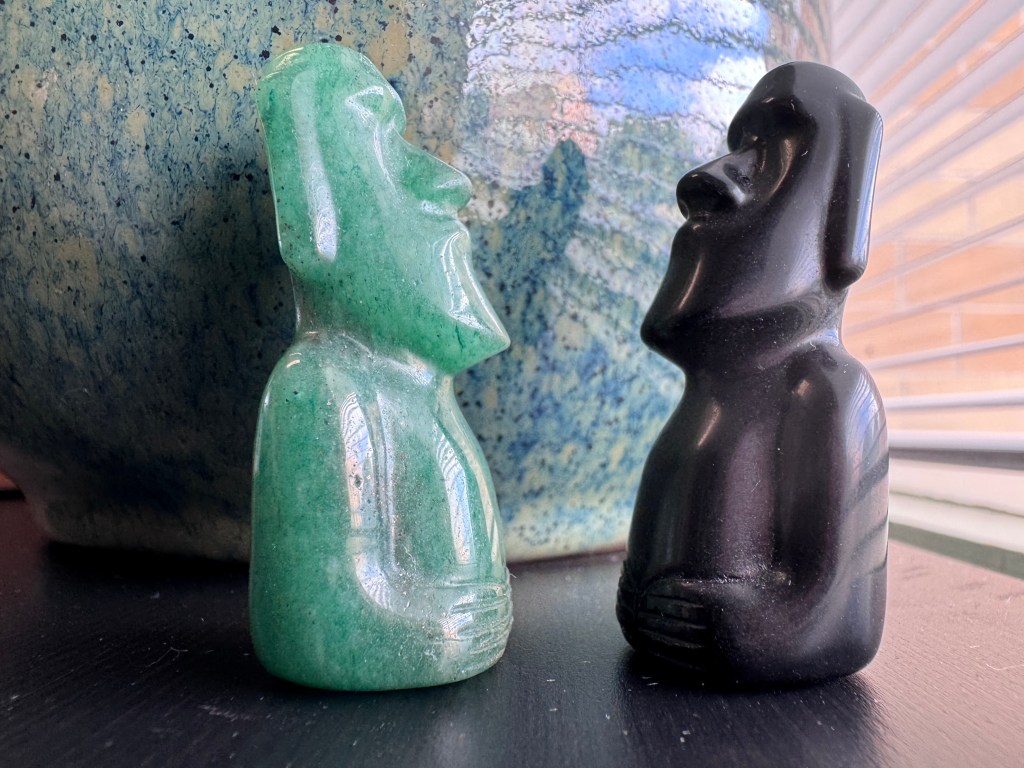
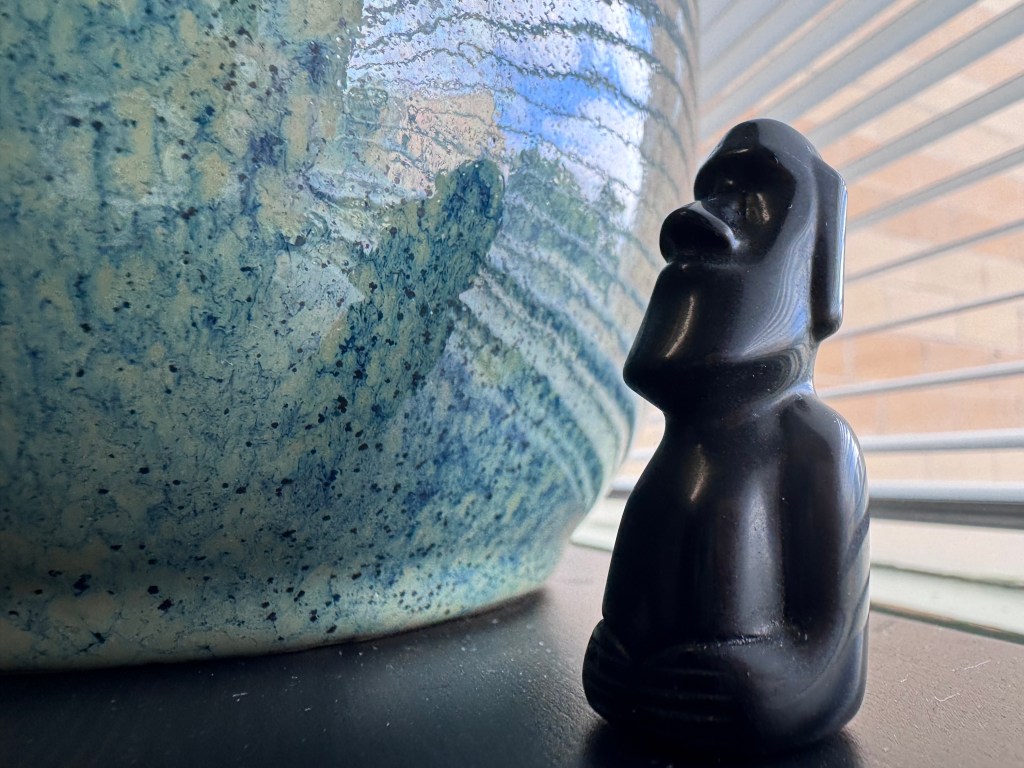
A lot of men come and go through my office, mostly fathers in my parenting psychotherapy work. But two men never leave. See photos: Meet my Moai! Two Easter Island/Rapa Nui statues I got from eBay. They stand in my office to remind me of the healing power of men.
Sometimes I even take them off the shelf and hand one to my patient and hold one myself. Being made of gemstone they are cool to the touch; it can be helpful to focus on physical sensations like this when dealing with trauma or conflict.
Let me tell you how these healing men came into my life. It was through working with a female patient, a mum.
She was a super-energetic go-getter mother of two who worked in healthcare and was ideally suited to the chaos of her department, always good in a crisis. Also terrible on weekends and holidays! She would come in the door each week with stories to tell, and I would find myself returning serve with her banter, getting carried along in her wake.
On this afternoon though, something shifted, and I found myself slowing down instead of trying to keep up with her. I breathed deeply, let my face stop smiling to mirror her smiles, and briefly closed my eyes.
In that moment I found myself picturing a Moai, though I didn’t know they were called that yet. It looked weathered by a thousand Rapa Nui storms and yet was still standing gazing over the Pacific, unperturbed by time or tide.
It seemed to say ‘yes, this way. Slow down. No hurry.’
So I kept that image in mind, trusting that it had arrived for a reason. And my patient, over the coming minutes, seemed to slow down too. She found some sadness, some tears I hadn’t seen before. They came and went, like the weather over the head of the Moai. I asked her how it felt to slow down, and she said it was good. Hard but good.
I told her about the Easter Island statue that had come to my mind, and that I wondered if it was in response to some need she had. She could imagine the place I was thinking of; she wasn’t sure what the need might be, but said that she was aware that my voice was slower and deeper than usual. We wondered about the experience of being in the room with a man who is slowing down, helping her to slow down.
Later that day I impulse bought some Moai on eBay. I didn’t bother to check the dimensions and so they turned out to be a bit smaller than intended. But they sit in the palm rather well.
I wound up using the Moai statuettes and imagery in future sessions with this patient. We worked out that if I found myself slowing and deepening my voice, there was something in the room with us, about her need to slow down with me. Before long that way with one patient became a tool in my therapeutic toolbox; I use it quite a lot now, with dads and mums alike, and even with babies and small children in the room.
I love that I am using my deeper voice therapeutically. There aren’t many men in my field, and I want to attract more to join me; imagine if they knew they have a superpower in their bodies?
We need to do more than imagine; here in 2026, my 20th year working in perinatal mental health, I’m still asking as I did two decades ago: where are the men? I have got involved with the fledgling field of fathers’ mental health, and the flourishing Australian Fatherhood Research Consortium; in my practice I see 50:50 mums and dads including in couples. But at conferences on infant and parent mental health, the queue for the loos is still very much the women’s.
We blokes are single digit percentages in so many rooms where the wellbeing of families – dads included – is on the agenda.
Where are the men? It’s not just in my field that I am asking that. It’s out there in the world too. Louis Theroux’s documentary Into The Manosphere is doing what Adolescence did last year, lighting up the socials with sad wreckage posing as manhood. Meanwhile the world’s autocrats and tech bro squillionaires are having a historical moment we all saw coming but couldn’t seem to prevent. Should we really call those twisted little boys in adult bodies…men?
I would love to save the word man for a boy truly grown into adulthood enough to be what the world needs men to be. Caring, thoughtful, sensible, kind, wise, courageous, principled, generous, playful, enthusiastic. But above all, a keeper of safety for himself and for others, especially those close to him.
But I am not sure that excluding the male humans who don’t meet that standard from manhood won’t just worsen the shame cycle. It’s harder, but decent men must reach out to the others and invite them to join the mission of safety for our people and our planet.
We need to balance responsibility with validation to prevent the shame that too often kicks in and cuts men off when faced with their responsibilities.
For example, I say to hetero men in my practice regarding being safe to know and live with: evolution gave you a bigger body with longer limbs, and a deeper voice than your kids and their mum. You have the power to be scary, or physically harmful. There are good reasons for this: we can imagine times when men in a tribe could use that ability to scare off predators and other tribes.
But if your kids or their mum find you scary, then their safe place at home with you doesn’t feel safe, and that’s a big problem for your relationships and their development. And your development too. You need to be able to look them in the eye and say: it means everything to me to be safe for you. If I am ever scary, that is not ok, and I will learn to do better. I will get whatever help I need to be here for you, and safe for you.
It’s intense stuff, and so much of it really emphasises neutralising threat over seeking opportunity. We need both.
That’s why amid all this stuff about men and their big scary voices – in person and online – I am talking about a beautiful and precious way forward I think is hiding in plain sight.
A man may use his deeper, louder voice and bigger body to protect his people from threats or to cause threat to his people. But he can also choose slow and low, and harness the same capacities for soothing. Healing even.
I first felt this at work with my patient, but it was a capacity that was already there:
Go slow and low, rest and digest, breathe deeply, let the weather come and go. Let the shoulders and eyebrows fall below the horizon.
And so came the Moai, healing men who help me be a healing man. Together we use a kind of therapeutic masculinity – alongside training and common humanity – to help men and women to heal themselves and each other, providing healing homes for their kids.
#psychiatrying
 My Doctor's Handwriting