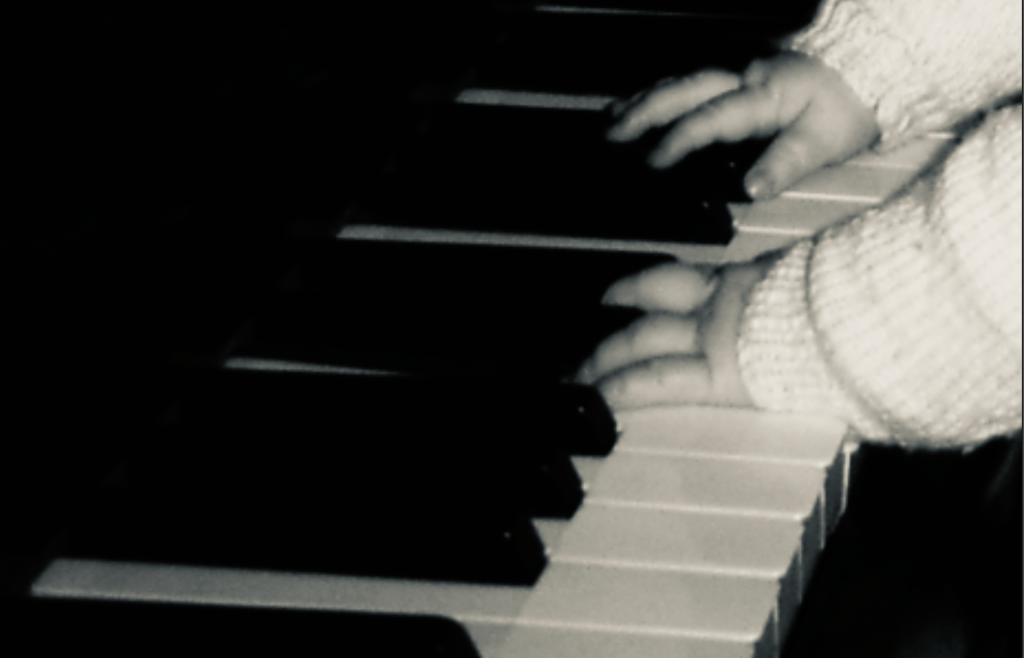
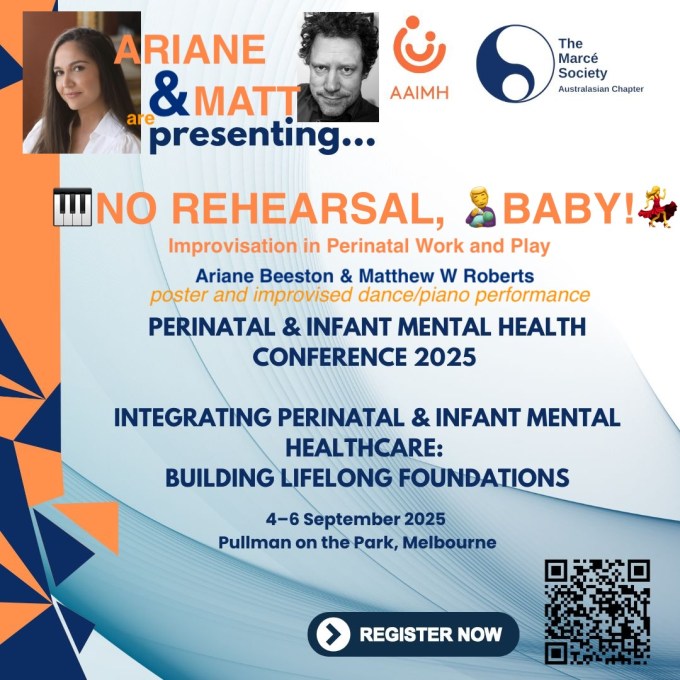
Just after 6pm on Friday 5th Sep 2025, I will sit down at a piano keyboard by a hotel dance floor in the presence of hundreds of my colleagues in the perinatal and infant mental health field. On the dance floor, my friend and psychologist/writer colleague Ariane Beeston will stand at the ready.
As the room falls quiet, Ariane will begin to move to music I will play, for about 5 minutes.
I have no idea what I am going to play.
She has no idea how she will move.
This is both thrilling to us, and terrifying.
But it’s a risk that means the world to us to take before our peers.
We all live and work in such a careful world, so aversive to risk. It’s even more pronounced around babies. Be careful! Prepare first! Plan everything! But of course, babies don’t prepare or plan.
There’s no rehearsal! Every moment they live is the real thing. Live.
You know who else plays live without rehearsal? Improvisational jazz musicians in the tradition that emerged from the US in the 1950s. Miles Davis famously insisted his musicians save their practising for the stage.
Keith Jarrett, my inspiration for piano improvisation, has similarly avoided rehearsing. There’s also a proud tradition in improvisational dance, of moving as the moment leads us.
That’s what Ariane and I want to honour in our 5 minutes of unplanned art in such a public place – the innate ability of babies to work with what’s already here.
To play without a plan.
One of the tasks of the first weeks of life, especially for first-time parents, is to learn this jazz-like ability from your baby. You had it once too! But this world insists we bury it and learn the ways of the adults, all careful planning and following instructions.
So we come to new parenthood expecting there to be a way we can learn from a book, and if we just prepare more, practise harder, all will be well.
Babies know differently. They arrive ready to connect – far from the ‘eating and pooing machine’ we have been told to expect by some – and with remarkable abilities to discern change and contrast in their environment over time.
Time and feeling collide; the remarkable scientist and writer Daniel Stern told us babies’ feelings don’t have names like anger, sadness, fear, joy so much as shapes. Crescendoing distress, for example, or spiking excitement.
He called these Vitality Affects, feelings defined by their shape over time. He also said dance and music capture the same feelings.
So it’s no surprise to discover that Stern was good friends with the great West Side Story choreographer Jerome Robbins. Movement that moves paying adults in theatres everywhere shares DNA with the movement we arrive with.
I bought Stern’s book The Interpersonal World of the Infant from Readings in Carlton, on a walk from the hospital while my wife and newborn were sleeping. Yes, I needed the manual too! But reading it taught me I was going to need to learn to let go, to read less book, and more my baby’s rhythms. To meet him where he was.
I remember watching my newborn’s face as he slept lightly one sunny spring afternoon, while small white clouds passed in front of the sun. Little clouds seemed to pass across his face too. It really was a moment by moment thing, how he seemed to be feeling.
And a moment by moment thing it will be too, on the Friday night when Ariane and I set out to celebrate babies, their loved ones and all who care for them.
But there is one caveat.
We are not Miles Davis. We have decided to plan just a bit!
A pure improv would have no theme at all. But babies are our theme, and so we have decided to improvise on a theme of Newborn Life, in which Stern describes the baby as developing an Emergent Sense of Self.
Selma Fraiberg called her chapter on this period in her classic book The Magic Years, ‘Shake Off Slumber, And Beware…’ after a quote from Shakespeare’s The Tempest.
In her writing, as with that of Stern or Melanie Klein, there is a sense of a baby’s powerful feelings, of emerging from darkness shrouded in dreamlike mystery. Clouds pass in front of the sun at times, at other times we go through storms together, in which minutes seem to pass like years.
Babies do weird things with time, this is why the nurse told us the nights are long but the years are short. My baby turns 18 this month!
On the night of our performace, time will be short. Ariane and I will play around with the time we have, but hope to capture something of that emergence of being, from timeless darkness into rhythm and light.
Because light there always is, in increasing quantities. The first time your baby cracks a full-bore social smile it stays imprinted on your retinas forever.
We will start out in darkness, and over 5 minutes take our audience with us through the first couple of months, ending up at that smile. At that point we will invite people to come on to the dance floor and move with us, as the baby is now so ready to meet their community.
Who knows, maybe there will be an actual baby or two there, ready to move with us, mess with time, make it up as we all go along.
 My Doctor's Handwriting